Most business continuity plans look fine on paper, but fall short in practice. They describe scenarios, list contacts, and outline intent — but don’t give teams what they need to respond under pressure or provide real assurance to boards, investors, and insurers.
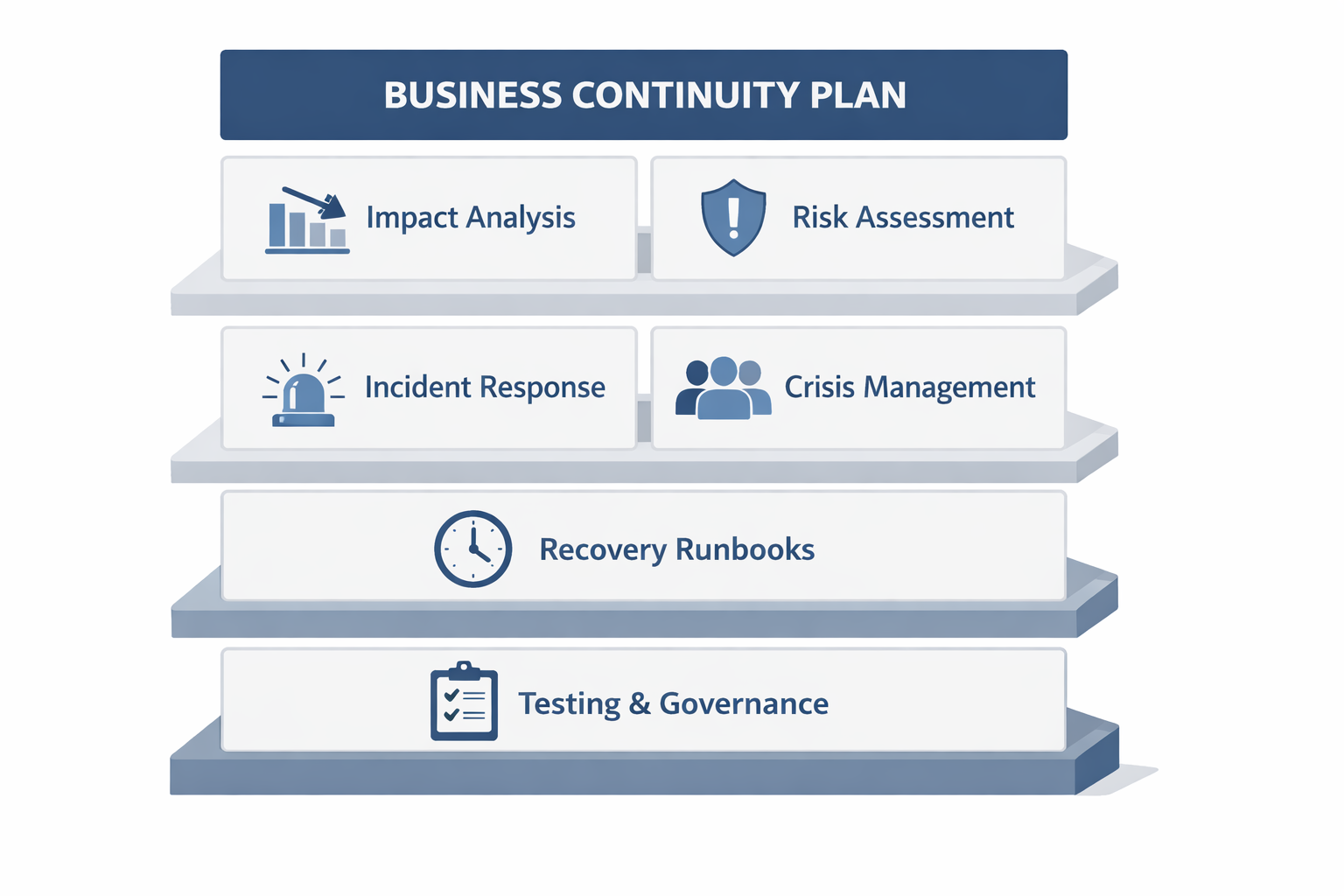
This checklist is based on real BCP reviews and defines what a complete, workable plan set should include in 2026. You can use it to assess your current position, benchmark suppliers, or shape a scoped BCP refresh.
What a good business continuity plan looks like
1. Clear definition of “impact”
You should be able to answer:
- What counts as a significant incident?
- What are the thresholds (financial, service, reputational)?
If this isn’t defined, decisions during incidents will be inconsistent.
2. Agreed impact tolerances (not just scenarios)
Plans shouldn’t just describe “short / medium / long disruptions”.
They should:
- Define unacceptable levels of impact
- Show how impact increases over time
Without this, prioritisation becomes guesswork.
3. Identified and prioritised stakeholders
A good BCP identifies:
- Who relies on your services (customers, regulators, partners)
- How sensitive they are to disruption
- When impact becomes unacceptable
Most plans reference stakeholders — far fewer actually prioritise them.
4. Mapped critical services and processes
You should have:
- A clear list of critical services
- The processes that deliver each one
- A single joined-up view
If this is split by department, recovery becomes fragmented.
5. Full dependency mapping
For each critical process, you should know the dependencies:
- People
- Systems / IT
- Facilities
- Suppliers
Without this, recovery plans tend to miss the things that actually break delivery.
6. Structured continuity risk assessment
A usable plan includes:
- A formal risk register
- Risks linked to business impact
- Defined continuity scenarios
If risks aren’t structured, strategies tend to stay generic.
7. Incident response procedures (not just intent)
There should be:
- Clear containment actions
- Defined responses for key incident types
- Referenced or standalone response plans (e.g. cyber, site loss)
High-level intent isn’t enough in the first hour of an incident.
8. Clear escalation triggers and flow
You should be able to see:
- What triggers escalation
- Who decides
- Who is notified, and how
If escalation is unclear, incidents are either missed or escalated too late.
9. Defined crisis roles (with named owners)
A workable plan includes:
- Named individuals in key roles
- Deputies for each role
- Clear responsibilities
Role structures without ownership don’t hold up under pressure.
10. Structured communications framework
Look for:
- Who communicates with which stakeholders
- What they say
- When they say it
Contact lists on their own don’t solve communication during a crisis.
11. Scenario-based recovery runbooks
Each key scenario should have:
- A defined recovery strategy
- Step-by-step actions or checklists
- Coverage of non-IT workarounds
If recovery is generic, teams slow down when decisions matter most.
12. Evidence of testing and ongoing governance
A “working” BCP isn’t static. You should see:
- Evidence of exercises or testing
- Ownership for updates
- A defined review cycle
Without this, plans drift out of date quickly — even if they looked good when first written.
Using this as a gap assessment
You don’t need a perfect plan to start improving, but you do need structure.
As a guide:
- If a handful of these are missing, you likely have a document rather than a working BCP
- If most are missing, your response will rely on ad hoc decisions during an incident
- If all are in place, you should be able to respond consistently and give clear assurance to stakeholders
In practice, most organisations sit somewhere in the middle — with elements in place, but without the structure linking impact, risk, response, and recovery.
That’s typically where a focused BCP refresh or a clearly defined statement of work is needed.