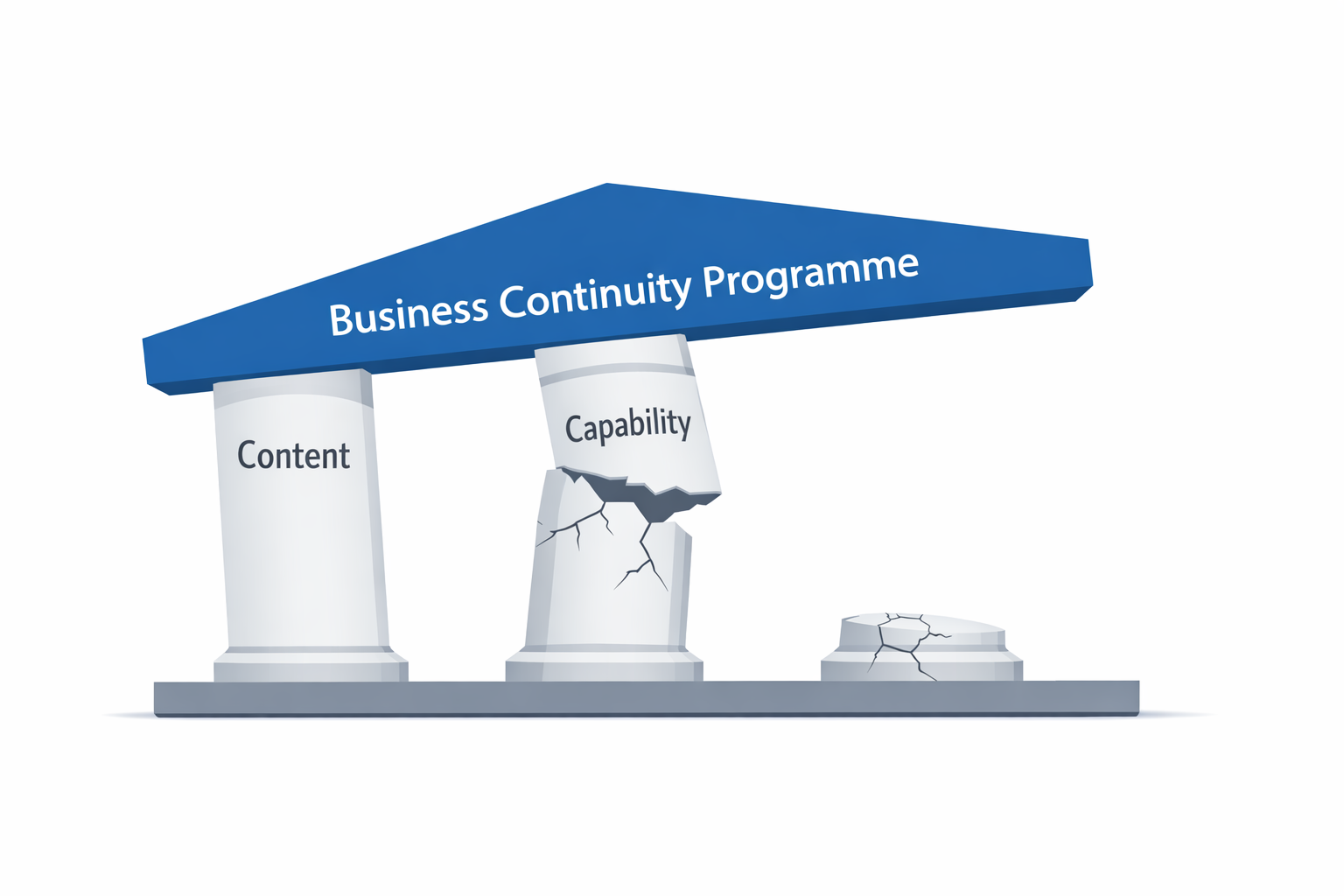
Most business continuity planning fails not because organisations lack plans, but because the programme behind those plans never embeds. Across mid-market organisations, the same issues repeat: unclear ownership, weak governance, and poor alignment with ISO 22301.
As business continuity consultants, we see this repeatedly across mid‑market organisations: plans exist, audits pass, but capability isn’t there when it matters.
Here are the 12 most common failure points — and what to do about them.
1. Treating Business Continuity as a Project, Not a Programme
What goes wrong
BCP is delivered, signed off, and parked. It gets dusted off in 12–24 months when someone asks for it again.
Fix
Split your approach into:
- Content (plans, framework)
- Capability (training, exercising)
- Control (governance, review)
Make only the first one a “project”. The other two must run continuously.
Owner: Head of Risk / Resilience
Timeline: Immediate reset, embed within 3 months
2. No Clear Ownership Beyond the Document
What goes wrong
Someone “owns” the plan, but no one owns whether it actually works.
Fix
Define owners for:
- Plan maintenance
- Training completion
- Exercise delivery
- Annual review
Tie each to objectives, not just responsibilities.
Owner: Executive sponsor + BC lead
Timeline: 4–6 weeks
3. Training Is Treated as a Tick-Box
What goes wrong
One annual session. Partial attendance. Forgotten within weeks.
Fix
Move training onto an LMS:
- On-demand completion
- Built-in testing
- Automatic tracking
- Integrated into onboarding
This removes the single-point-in-time problem.
Owner: HR + BC lead
Timeline: 6–8 weeks
4. No Coverage for New Starters or Leavers
What goes wrong
You train 60% of people once a year. A year later, half your trained staff have moved on.
Fix
Make BC training part of:
- Induction (mandatory)
- Role changes (triggered)
- Refresher cycles (quarterly/light touch)
Owner: HR
Timeline: Immediate policy change
5. Exercises Are Weak or Irrelevant
What goes wrong
Exercises are:
- Too generic
- Poorly facilitated
- Not linked to real risks
They create activity, not insight.
Fix
Base scenarios on:
- Actual risk assessment outputs
- Known weak points (IT, suppliers, people gaps)
And facilitate them properly so they test decisions, not just discussion.
Owner: BC lead / external facilitator
Timeline: Next exercise cycle
6. Scenarios Don’t Reflect Real Risk
What goes wrong
Organisations design scenarios before they properly understand impact and dependencies.
Fix
Re-anchor exercising in:
- BIA outputs
- Dependency mapping
- Maximum tolerable downtime
If the risk picture changes, the exercise plan changes.
Owner: BC lead
Timeline: Align at next annual review
7. No Regular Review Cycle
What goes wrong
Plans sit untouched until:
- Audit
- Incident
- Customer request
Fix
Implement a formal cycle:
- Quarterly light-touch review
- Annual full review
- Roadmap for improvements
This aligns with ISO-style management system expectations around continual improvement [Checkout Framework | Word]
Owner: BC lead + governance forum
Timeline: Immediate
8. Governance Exists on Paper Only
What goes wrong
Policies and frameworks exist, but:
- No active oversight
- No meaningful reporting
- No challenge from leadership
Fix
Create a live governance structure:
- Quarterly resilience forum
- Clear MI (training %, exercise outcomes, gaps)
- Action tracking with accountability
This is where “control” actually happens.
Owner: Executive sponsor
Timeline: 1–2 months
9. No Defined Deliverables, Owners, or Timelines
What goes wrong
The programme has ambition but no delivery structure.
Fix
Define:
- What gets delivered (plans, exercises, reviews)
- Who owns each output
- When it must be completed
Treat BCM like any other operational programme.
Owner: BC lead
Timeline: 2–4 weeks
10. Over-Reliance on Annual Activity
What goes wrong
Everything happens once a year:
- Training
- Exercising
- Reviews
The organisation is then exposed for the other 11 months.
Fix
Move to smaller, more frequent actions:
- Quarterly micro-training
- Targeted exercises
- Rolling plan updates
Owner: BC lead
Timeline: Next programme cycle
11. Capability Isn’t Measured
What goes wrong
Organisations assume they are capable because:
- Plans exist
- Training was delivered
- Exercises were run
But no one measures outcomes.
Fix
Track:
- Training completion and test scores
- Exercise performance (decision speed, gaps)
- Time to mobilise response teams
Owner: BC lead + governance forum
Timeline: 1–2 months
12. No Link Between BCM and Business Change
What goes wrong
The business evolves (systems, suppliers, structure), but the BCP does not.
Fix
Integrate BCM into:
- Change management
- Project delivery
- Supplier onboarding
So continuity is updated as the business changes.
Owner: PMO / Risk / BC lead
Timeline: 2–3 months
The Pattern Behind Most Failures
Across all of these, the root cause is consistent:
- Organisations focus on content
- They underinvest in capability
- They ignore control
A functional business continuity programme needs all three.
That’s what separates a set of documents from a system that actually works.