Most organisations already have both a cyber incident response plan and a business continuity plan.
The problem is they don’t join up.
The cyber plan sits with IT or security, focused on detecting and containing threats. The business continuity plan sits somewhere else, usually written for compliance, focused on keeping the business running.
Individually, both can be reasonable. Together, they often don’t work.
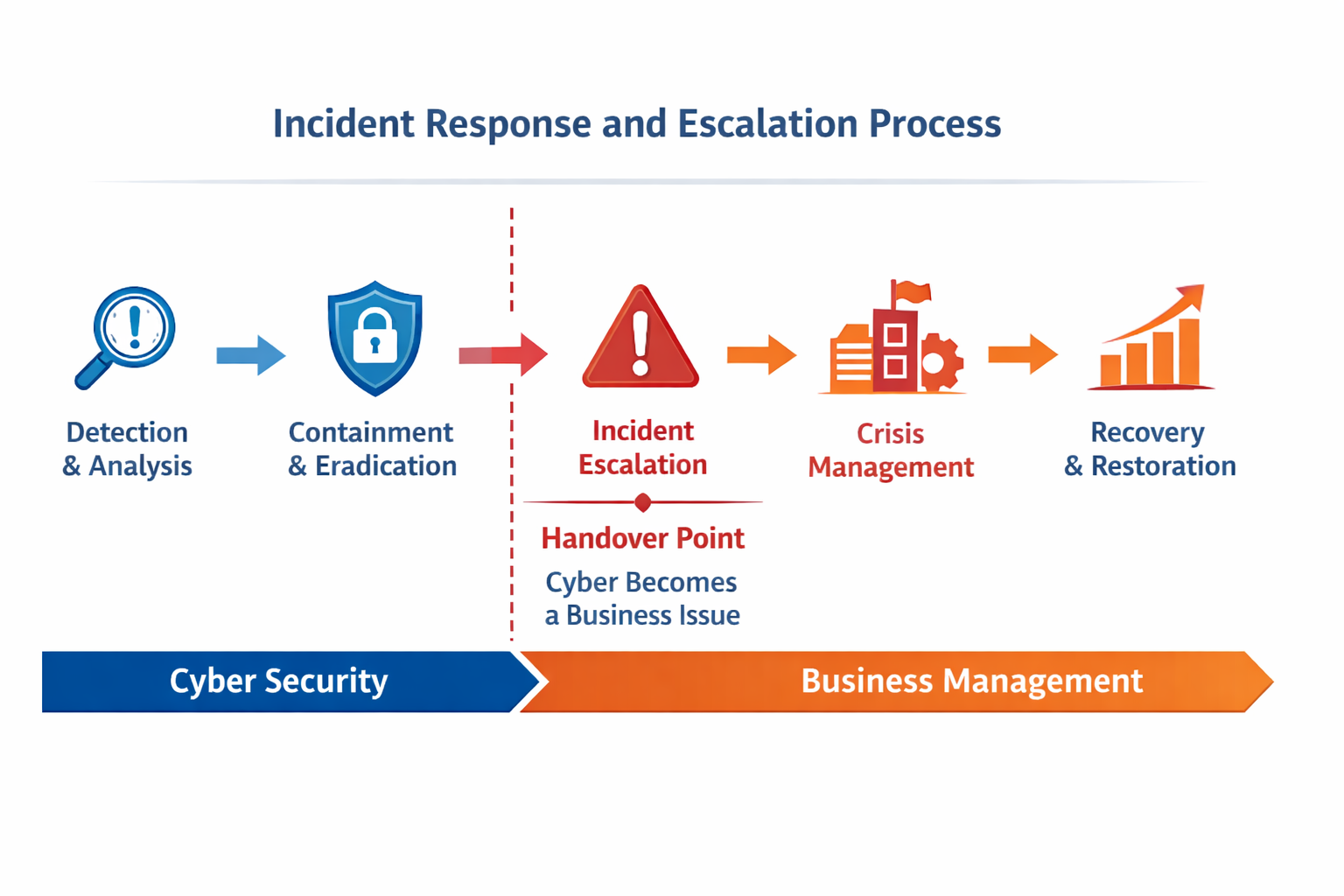
Integrating cyber incident response and business continuity is mainly about defining when a cyber incident becomes a business issue, and ensuring there is a clear escalation from technical response into crisis management and recovery.
The gap shows up at exactly the wrong moment — when an incident stops being a technical issue and starts affecting the business.
That handover point is rarely defined clearly. And when it isn’t, things slow down, get duplicated, or get missed entirely.
Where does cyber incident response end and business continuity begin?
A simple way to think about incidents is as a progression:
- something abnormal is detected
- teams try to contain it
- a decision is made about how serious it is
- the organisation responds
- the business recovers
Cyber incident response is strong in the first two steps:
- detecting activity
- investigating and containing it
That’s where most cyber plans stop.
But many cyber incidents do not end at containment. There is often disruption left behind — systems offline, data unavailable, processes broken, customers affected.
That’s where business continuity comes in.
The shift happens at one point:
“This is no longer just an IT issue — this is now a business issue.”
If that moment isn’t clearly defined, everything that follows becomes harder.
What triggers escalation from cyber to crisis management?
The join between cyber incident response and business continuity is escalation.
That sounds obvious, but in practice it’s where most organisations fall down.
There are three things that need to be clear.
1. Clear escalation triggers
Most plans say “escalate if severe” or “escalate if required”.
That’s not usable in an incident.
You need practical triggers, for example:
- loss of a critical system for more than X hours
- loss of customer-facing services
- confirmed or suspected data breach
- inability to meet key deadlines or regulatory obligations
- any incident likely to cause reputational impact
These don’t need to be perfect, but they need to be agreed.
Otherwise escalation becomes a judgement call made under pressure — and it usually happens too late.
2. Clear decision authority
You need to define:
- who decides whether to escalate
- what authority they have
- what happens if they are unavailable
Without that, you get hesitation or delay exactly when speed matters.
3. A clear mobilisation route
Even where triggers and ownership are clear, the mechanics are often weak.
Basic questions that are often not answered:
- who is contacted
- how they are contacted
- what happens in the first 30 minutes
- how the crisis team gets from “not involved” to “fully mobilised”
This is where many otherwise solid plans fall down — not because they are wrong, but because they are not operational.
What does a joined-up response actually look like?
When this is done properly, cyber incident response and business continuity are not separate tracks.
They are one flow with a clear handover.
In practice:
- the incident team focuses on detection, containment, and technical response
- escalation triggers are defined and understood
- once triggered, the crisis team takes control of coordination and decisions
- recovery priorities are set by business impact, not just technical order
- recovery moves from critical to less critical in a structured way
You still have different teams — incident, crisis, recovery — but they are connected.
Not operating in parallel, and not duplicating each other.
Where most organisations go wrong
Across the plans we review, the same issues come up again and again:
- cyber plans stop at containment
- business continuity plans assume escalation has already happened
- trigger points are vague or missing
- escalation is inconsistent
- mobilisation is unclear
- roles overlap or get duplicated
- too much focus is placed on documentation rather than decisions
None of this is usually deliberate. It’s just what happens when plans are developed separately.
How do you practically integrate cyber and business continuity?
You don’t need to rebuild everything from scratch.
Most organisations already have the pieces. What’s needed is alignment.
At a minimum:
- define a single set of escalation triggers used by both cyber and business continuity
- agree who has authority to escalate
- map a clear handover from incident response to crisis management
- align roles so teams are not duplicating effort
- define what happens in the first hour after escalation
A simple structure helps:
- incident team (technical response)
- crisis team (decision-making and coordination)
- recovery teams (restoring services)
With clear points where responsibility shifts between them.
Test it properly
The easiest way to see whether this works is to run a cyber-led scenario.
For example:
- ransomware affecting a key system
- loss of a key SaaS platform
- data breach with unclear scope
Then watch what actually happens:
- when escalation happens
- who makes the call
- how quickly the crisis team is mobilised
- whether roles are clear or overlap
- whether recovery priorities match business impact
Most issues become obvious very quickly.
Final thought
This is not really about integrating documents.
It is about answering one question clearly:
At what point does this stop being a technical issue and become a business problem — and what happens when it does?
If that is clear, the rest tends to follow.
If it isn’t, no amount of documentation will fix it in a real incident.
FAQ
What is the difference between cyber incident response and business continuity?
Cyber incident response focuses on detecting, containing, and investigating technical incidents. Business continuity focuses on maintaining and recovering business operations when those incidents cause disruption.
When should a cyber incident be escalated?
When the incident is likely to impact critical services, customers, regulatory obligations, or reputation — not just when it is technically severe.
Why do cyber and business continuity plans fail to integrate?
Because they are often created separately, with no shared escalation triggers, no clear handover, and unclear ownership once the incident affects the wider business.