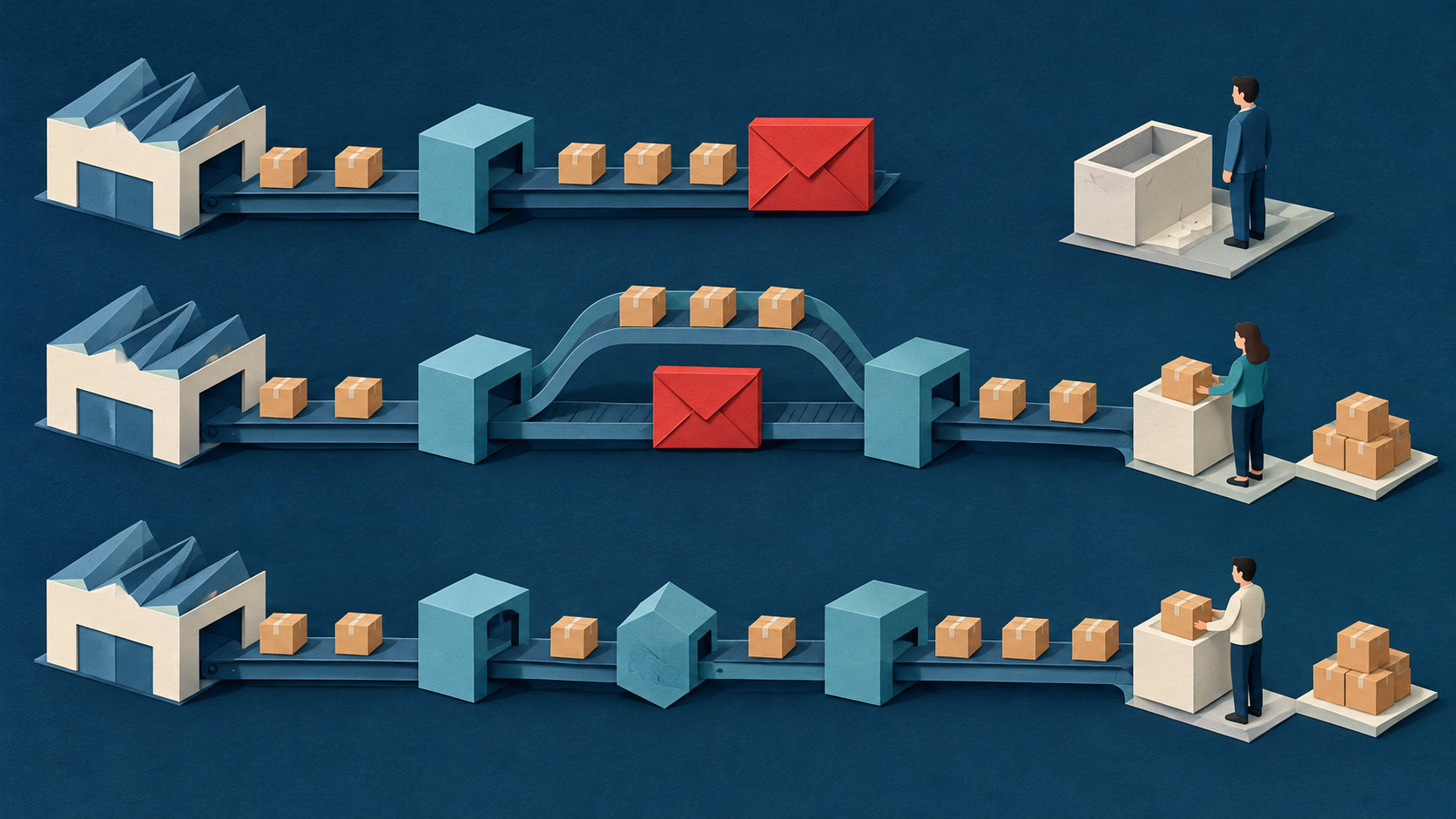
The Microsoft 365 outage that began on Thursday 12 November and continued into Friday disrupted email and other workplace services internationally. Affected Outlook users were unable to send or receive messages, or load their inboxes. Reporting on the incident described disruption extending beyond office inconvenience to public services.
An incident like this can feel as though it must be a business continuity event: it is conspicuous, outside our control, and interrupts the way people normally work. But how exceptional an incident feels is not the same as how seriously it threatens the delivery of our critical products, services and outcomes.
Many of our customers told us during business impact analysis that they could cope for a day or more without Microsoft. For those businesses, the first question was whether the outage was causing more harm than they had expected. If not, they might reasonably manage the disruption while waiting for restoration. But they still needed to decide what to do if it lasted longer.
Nor was it a reason to do nothing. During the outage, nobody could assess their response with the benefit of knowing its final duration. The useful question was not simply “is this a BCP event?” but “what is happening to critical delivery, and what decisions do we need to make now if the disruption continues?”
What had we actually said we could tolerate?
I don’t know whether this was a continuity event for most firms. The scale of the outage cannot answer that on its own. I’d start by comparing the impact on each organisation with what its BIA had said would be tolerable.
That is not about using the BIA to explain away disruption. It is a chance to test whether the analysis was realistic. Did the business manage as expected, or did it discover that an activity was more dependent on email than anyone had recognised?
The phrase “we can manage a day without Microsoft” is only useful if we understand what managing means. Some work may wait. Some may need a workaround. Some may have to continue. That takes us back to the critical value streams.
Which critical value streams relied on email?
If we have defined the end-to-end delivery of our important products, services and outcomes, we have a practical starting point: which of those streams critically relies on email, and at which step? Using email throughout the business is not the same as needing it to sustain every outcome.
The incident showed why that question matters. Some healthcare providers advised patients to telephone rather than email, while businesses in the aviation industry reported disruption to customer-support email services. Behind the common technology failure were different delivery problems.
As a hypothetical example, a service might still be able to fulfil customer requests but be unable to receive them through its usual inbox. The problem is at intake. An alternative contact route could help, but only if requests can then pass through the rest of the stream to completion.
That is the level at which I’d test the tolerance. What outcome is delayed, for whom, and for how long? A department may look busy and operational while a handover elsewhere has stopped delivery. Equally, frustrated staff and lost productivity do not, by themselves, establish that a critical outcome is outside tolerance.
Within tolerance does not mean nothing to manage
Suppose the assessment held up: the affected value streams could withstand the interruption for a day. There would still be work to do: assess the changing impact, coordinate staff, keep customers informed and track the requests accumulating for later action.
Waiting for restoration could be a reasonable response. But it should be an active decision, with someone monitoring whether the basis for it still holds.
The difficult part is that we only know the final duration afterwards. During the incident, “we can manage a day” does not tell us whether the service will return before that day is over. And an alternative that takes time to activate cannot sensibly be left until the tolerance is exhausted.
That is where I’d expect crisis management to contribute when the uncertainty warrants it: setting priorities, deciding when to change course and giving people authority to act. Not every email outage needs a full crisis response. But being within tolerance is not a reason to avoid those decisions.
What options would have changed the outcome?
Once we know the affected stream and when its interruption becomes unacceptable, we can have a useful conversation about contingencies. The question is not whether we could reproduce every Microsoft function. It is what would let the important work continue, or make a pause and restart manageable.
For the hypothetical request-handling service, that might mean a published phone number, staff able to answer, and a secure way to record and hand over requests. I’d test the request through to delivery, not stop at proving that the phone rings.
A backup email service might be justified elsewhere. But it needs the same test: can we access the information it needs, can the people at the other end respond, and does it avoid the failed dependency? If customers or suppliers are also affected, restoring our side may not restore the stream.
Where continued delivery is not realistic, the response still has a purpose: preserve outstanding requests and commitments, limit the consequences of delay, and prepare for an orderly restart. That is more useful than assuming either that everything must continue or that nothing can be done.
Does that mean relying less on big tech?
Possibly, but that is a decision to reach through the analysis, not the starting instruction. Moving provider, duplicating services or bringing work in-house should address a specific exposure in delivery.
Changing supplier may move a dependency rather than remove it, and using multiple cloud providers brings its own complexity. The case for investment is stronger when we can say which stream it protects, what impact it reduces and why a simpler workaround would not be enough.
A practical next step is to rehearse one critical value stream without email, including the decisions needed as time passes.
The test is not whether it felt like a crisis
We didn’t need to predict the precise failure inside Microsoft to prepare for losing a service our value streams depended on. But preparation need not mean uninterrupted delivery at any cost. It can mean understanding what we can tolerate, having credible options and knowing when to use them.
The useful review after this outage is therefore:
- Did our BIA match what actually happened to our critical value streams?
- Did we manage the uncertainty and make timely decisions before our options narrowed?
- What specific gap in delivery or recovery would justify changing our arrangements?
Being able to tolerate an outage is not the same as being able to ignore it. That, for me, is the preparation question this incident leaves behind.